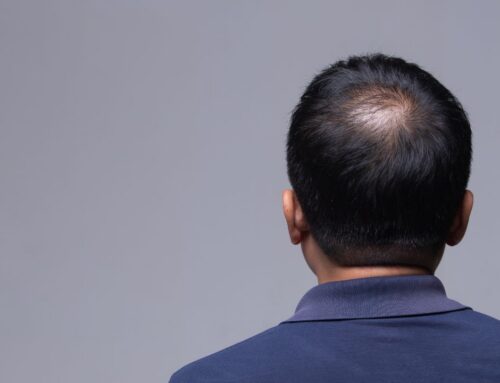
Scarring hair loss in women starts with inflammation that destroys the hair follicle’s growth center. Once a scar forms, that follicle can’t grow hair again, which is why early diagnosis and fast treatment are so critical. The goal is to stop the inflammation before it causes more permanent damage, while managing uncomfortable symptoms like burning, itching, pain, and pus-filled bumps.
What “scarring” means in hair loss (and why early diagnosis matters)?
All the scarring hair loss conditions we’ll discuss begin the same way: inflammation attacks and destroys the follicle’s stem cells, the growth center that makes new hair. The end result is scar tissue, and hair from a scarred follicle doesn’t come back.
That’s why doctors emphasize catching these conditions early. The faster you can calm the inflammation, the more hair you can save from permanent loss.
The main subtypes of hair loss scarring you should know about
Frontal Fibrosing Alopecia (FFA): Inflammation that starts along your frontal hairline and gradually pushes it backward. Eyebrows are often affected too. While it’s seen mainly in women, men can get it as well, and some cases run in families or appear in younger patients.
Lichen Planopilaris (LPP): Usually shows up as patchy areas of hair loss on the scalp. Under the microscope, it can look very similar to FFA.
Pustular/inflammatory pattern: Seen more often in Black women and Indian patients, this presents as pimples and pustules on the scalp with aggressive inflammation that can damage multiple follicles in one spot. It later leaves behind large, flat scars.
Lupus of the scalp: An autoimmune condition that can look like LPP on the surface. Doctors rely on scalp biopsies, your medical history, and blood tests (sometimes specialized ones) to tell them apart.
Other conditions that can complicate the picture: Blistering diseases, dermatomyositis, seborrheic dermatitis (the itching and flaking can reduce hair growth), scalp hardening related to scleroderma (especially on the front of the scalp), and fungal infections (in kids who’ve touched infected animals, or sometimes in older adults). If your scalp is very scaly, your doctor may need to culture it.
FFA vs. LPP: are they related or different?
They can look similar both to the naked eye and under a microscope, so some experts think they exist on the same spectrum. However, genetic research has identified differences between these conditions, suggesting they’re not exactly the same disease.
A note on sunscreen and FFA
Here’s something surprising: survey data has linked titanium and zinc sunscreens to higher rates of FFA. Because of this, some specialists now advise their FFA patients not to apply sunscreen directly on the face, hairline, or eyebrows, or to use products with SPF under 15, and instead rely on hats and sun avoidance.
That said, doctors acknowledge this is a bit of a puzzle since sun protection is still important for other reasons. More research is needed to give clearer guidance.
How is treatment approached?
Because scarred follicles won’t regrow hair, treatment isn’t about reversing the damage; it’s about stopping the condition from marching forward and easing your symptoms:
- Injections: Steroid injections directly into the affected scalp areas every 4-6 weeks are used frequently.
- Topicals: Steroid creams or solutions, non-steroidal anti-inflammatory options like tacrolimus, and minoxidil applied to the scalp.
- Oral medications: Oral minoxidil, anti-androgen therapies (like spironolactone or dutasteride), and antibiotics (such as doxycycline; tetracycline has also been used historically and for cost reasons).
- If you have crusting or pus: Your doctor may culture the area because some cases show staph bacteria. An antibiotic called sulfacetamide can help clear up bacterial involvement.
Light-based therapy is also in the toolkit.
Doctors stress that there’s no one-size-fits-all treatment plan. Your regimen will be customized based on how your condition presents, your overall medical history (many patients also have type 2 diabetes), and which therapies you can tolerate. For most people, this is long-term management, often lifelong.
Is a hair transplant an option for hair scarring?
Rarely, and with extreme caution. One surgeon’s protocol requires patients to be completely symptom-free for at least two years off all treatment before even considering surgery. Even then, there’s a real risk the disease could reactivate from the surgical trauma.
There have also been reports of FFA and LPP appearing after facelifts, which underscores just how careful doctors need to be. In three decades of practice, that surgeon has operated on very few patients with these conditions.
Camouflage that helps: scalp micropigmentation (SMP)
Scalp micropigmentation, essentially a specialized tattoo that mimics the look of hair follicles, has been described as psychologically life-changing for some women with visible bald patches. Several patients with significant areas of hair loss reported being very happy with their SMP results.
What does success look like?
Success with scarring hair loss isn’t about regrowing hair in areas that are already scarred. Instead, it means:
- Stopping further loss from happening
- Quieting symptoms like burning, itching, pain, and pustules
- Helping you feel and function better day to day
While some medical literature suggests these diseases can “burn out” on their own over time, doctors also see plenty of cases that continue progressing, which is why ongoing care and monitoring are so important.
Bottom line
Scarring hair loss in women is driven by inflammation that leads to permanent follicle damage if left unchecked. The most important steps are recognizing it early, starting treatment quickly, and setting realistic expectations: protect the hair you still have, calm your symptoms, and use tools like scalp micropigmentation when appropriate.
Treatment plans are highly personalized, and having a care team that gives you time, shows compassion, and follows through with you can make all the difference.

Meet Robert Haber, MD, FISHRS
Dr. Haber is considered one of the finest hair transplant surgeons in the world, and lectures internationally each year. He also directs the region’s busiest private clinical trials unit studying new medications.
In 2023, Dr. Haber was the recipient of the prestigious Manfred Lucas Lifetime Achievement Award by the ISHRS, for his exceptional contributions and commitment to the field of hair transplantation. Only 15 other surgeons globally have ever received this honor.
The International Society of Hair Restoration Surgery (ISHRS) awarded Dr. Haber the coveted Golden Follicle Award in 2009 as one of the world’s top hair transplant surgeons, in recognition of his academic contributions and surgical skills.