Introduction (0:00)
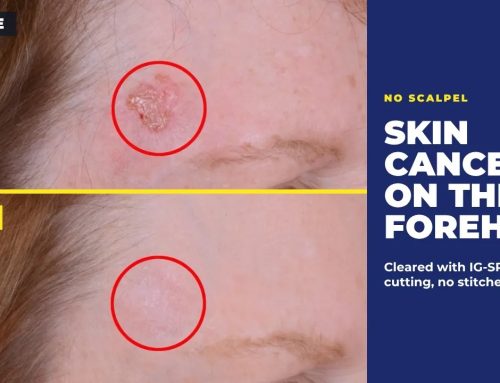
If you have skin cancer, specifically basal or squamous cell carcinoma, watch these videos before you undergo Mohs surgery to learn about IGSRT, image-guided superficial radiation therapy, a better alternative for almost everyone. You can treat your skin cancer and still look great.
Meet George (0:18)
Dr. Haber: Hi, I’m Dr. Bob Haber here at Haber Dermatology in Beachwood, Ohio, and I’m here with George. George has two skin cancers, one on the left cheek and one on the scalp, and he’s about to begin a round of IGSRT, or image-guided superficial radiation therapy, as an alternative to the Mohs procedure. George also had two cancers last year, one on each side of his nose, that were treated. So this is his second round.
Why George Chose IGSRT Over Mohs (0:44)
Dr. Haber: George, tell us why you chose IGSRT instead of the more invasive Mohs procedure.
George: At my age, I feel anytime I don’t have to have anesthesia to be put under to have surgery, it’s much safer for people of my age.
Dr. Haber: Got it. The Mohs procedure typically leaves a big hole that has to be closed. IGSRT has the highest cure rate for skin cancer and the best cosmetic outcome. Those are both very important.
What the IGSRT Process Involves (1:12)
Dr. Haber: For the IGSRT process, there are 22 visits. That’s the downside.
- 1 simulation visit (today): no treatment is given, but we determine the treatment parameters and set up safety protocols.
- 20 treatment visits: each one is fairly short, and I see the patient several times during the process.
- 1 follow-up visit six weeks after treatment.
The whole treatment program takes about 5 to 6 weeks, plus the six-week follow-up. During that time we also use ultrasound. That’s the image-guided part of the process, which shows the extent of the skin cancer and how it improves. It’s the image guidance that gives us that high cure rate.
We appreciate George allowing us to follow him through the entire treatment program.
The Simulation Visit (1:53)
Dr. Haber: Now I’m outlining the visible part of the skin cancer. Because of the type of skin cancer, I’m adding about half a centimeter of additional treatment zone. That way we catch any parts of the cancer we can’t see. Once the radiation therapist performs the ultrasound, she may need to adjust that further if we see additional cancer in that shadow.
The radiation therapist then:
- Performs the first ultrasound evaluation and confirms the depth and features of the skin cancer will be treated effectively as planned
- Fabricates and applies a lead shield and other protective materials so only the cancer receives radiation
- Determines the proper position of the radiation device
- Documents all final settings so they can be reproduced for every treatment session
That concludes the simulation visit.
Treatment Visits (2:48)
First treatment day: All parameters from the simulation visit are applied. This visit is very quick, taking only a few minutes.
Visit 5, first clinical evaluation (2:59): We make sure the patient understands what’s happening and has a chance to ask questions. There’s a hint of redness on the cheek, and the scalp still shows skin disruption from the cancer.
Visit 10, second clinical evaluation (3:12): Redness is more pronounced on the cheek, and the scalp is showing some redness around the cancer site.
Visit 15, third clinical evaluation (3:22): Redness remains pronounced on the cheek, and the scalp shows more redness around the cancer site.
Final treatment day, fourth clinical evaluation (3:31): Redness on the cheek is starting to improve, and the scalp is improving nicely.
Six-Week Follow-Up Results (3:41)
Dr. Haber: We’re at the six-week follow-up visit. Both of George’s skin cancer sites, the cheek and the back of the scalp, look terrific. Ultrasound shows dramatic improvement and will continue to improve over time. Every year we’ll repeat the ultrasound to confirm continued clearance.
As a reminder, here’s the cheek before, during, and after treatment, and the scalp before, during, and after treatment.
Ultrasound Before and After (4:16)
- Cheek, before treatment: All the dark areas represent cancer.
- Cheek, today: Those areas are filled in with healthy tissue.
- Scalp, before treatment: Severely disrupted skin with many cancerous changes.
- Scalp, today: Complete normalization of the treated area.
Close-Up of the Treated Skin (4:36)
Dr. Haber: Here’s what the treated areas look like up close at six weeks. On the cheek, the hair is gone, but the skin looks beautiful. It’s soft, with no residual redness or color change. This is a terrific result.
On the back of the scalp, the only evidence is the initial biopsy. The scalp isn’t discolored, and the skin is soft and looks terrific.
Ringing the Gong (5:07)
Dr. Haber: Now that George is cancer-free, thanks to GentleCure and IGSRT, he gets to ring the gong. Go ahead.
[Applause and cheering]
Dr. Haber: Well done. George, are you happy you chose IGSRT over the Mohs procedure?
George: I’m very pleased.
Dr. Haber: Are you happy with the way the skin looks?
George: Yes. I can’t see my scalp, but I can see the cheek. It’s very nice.
Dr. Haber: I think it looks terrific.
Is IGSRT Right for You? (5:32)
Dr. Haber: We partner with GentleCure to offer these treatments, and the results here are typical and excellent. If you have a basal or squamous cell carcinoma, consider IGSRT before you undergo a Mohs procedure. Call the number on your screen in the Cleveland area, or search for IGSRT to find a location close to you. You can treat your skin cancer and still look great.