Yes. Basal cell carcinoma, the most common skin cancer in the United States, can be treated without a scalpel. The option is image-guided superficial radiation therapy, or IG-SRT: a treatment that uses low-dose X-rays and ultrasound imaging to clear the cancer while leaving the surrounding skin intact.
For decades, surgery was the default. IG-SRT gives most patients a way to treat the cancer and keep the skin looking the way it did before.
How does Mohs surgery treat basal cell carcinoma?
Mohs surgery has been the standard treatment for basal and squamous cell carcinoma since Dr. Frederic Mohs developed it in the 1930s. The surgeon removes the visible cancer, then cuts progressively wider until lab-checked tissue comes back clear of cancer cells.
That process works. It also leaves a wound where the cancer was, often larger than the original spot. Closing the wound means more anesthesia, more cutting, and a scar that can end up several times the size of the cancer itself. On the nose, ear, or lip, that scar is hard to hide.
What IG-SRT does differently
IG-SRT treats the cancer from the outside. A high-resolution ultrasound maps the exact depth and width of the tumor, then low-dose X-rays target it across a series of short sessions. No cutting, no stitches, no anesthesia.
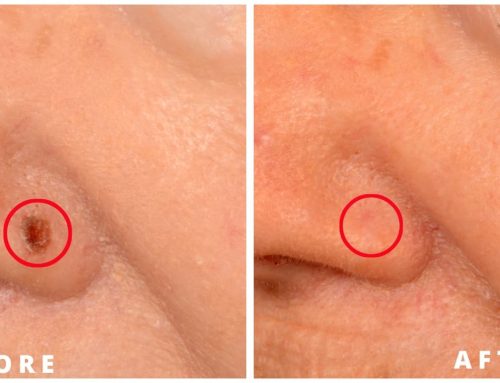
Because the treatment reaches the cancer through the skin rather than through an incision, there is no surgical wound to close and no scar to heal. The FDA cleared IG-SRT for skin cancer in 2015, and its use in dermatology offices has grown since.
Cure rates
Cure rate is the first question most patients ask, and it is the right one. Research reports a 99.6% cure rate for basal and squamous cell carcinoma, the highest published rate for the treatment. Peer-reviewed studies of IG-SRT have reported freedom-from-recurrence rates above 99% at two, four, and six years for early-stage cases.
Cosmetic outcome
This is where the two treatments separate most clearly. Surgery removes tissue and leaves a scar. IG-SRT leaves the surrounding skin in place. For cancers on the face, where a scar shows every day, the difference in appearance after treatment is the reason many patients choose radiation over the operating room.
Is Mohs surgery always necessary for basal cell carcinoma?
No. Mohs was the default for so long that many patients assume surgery is the only real treatment, but “standard” and “required” are not the same thing. For most early-stage basal cell carcinomas, surgery is a choice, not an obligation.
Mohs surgery is still the right choice in some cases. That includes tumors that grow deep below the skin, and more aggressive types that a biopsy can flag. In those situations, the surgeon checks the edges of the tissue during the procedure to make sure all the cancer is gone, which is worth the scar it leaves. Your dermatologist should be the one to make that call.
The typical early-stage basal cell carcinoma is a different situation. It sits near the surface, grows slowly, and responds to IG-SRT at the cure rates above. A patient with that kind of cancer can treat it without an incision and without giving up the outcome surgery would provide. The way to know which situation is yours is an exam, not an assumption.
Is IG-SRT right for every skin cancer?
Some skin cancers are still treated best with Mohs surgery, and a dermatologist should make that call based on the tumor type, its location, and how deep it goes. IG-SRT is the better choice for most basal and squamous cell carcinomas. It is not the right choice for all of them.
Talk to Haber Dermatology
Dr. Haber treats skin cancer with IG-SRT at Haber Dermatology in Beachwood, Ohio. If you have been diagnosed with basal or squamous cell carcinoma, or you have a spot you want checked, ask whether IG-SRT is an option before you schedule surgery.
Meet Robert Haber, MD, FISHRS
Dr. Haber is considered one of the finest hair transplant surgeons in the world, and lectures internationally each year. He also directs the region’s busiest private clinical trials unit studying new medications.
In 2023, Dr. Haber was the recipient of the prestigious Manfred Lucas Lifetime Achievement Award by the ISHRS, for his exceptional contributions and commitment to the field of hair transplantation. Only 15 other surgeons globally have ever received this honor.
The International Society of Hair Restoration Surgery (ISHRS) awarded Dr. Haber the coveted Golden Follicle Award in 2009 as one of the world’s top hair transplant surgeons, in recognition of his academic contributions and surgical skills.