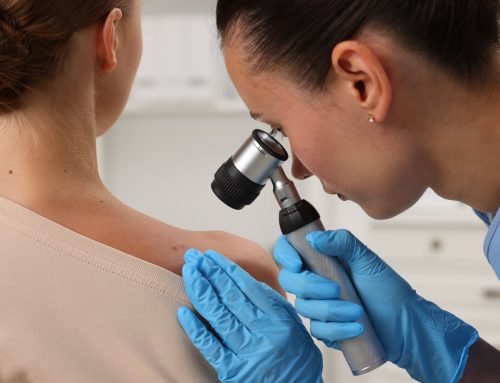
If you’ve been diagnosed with basal cell carcinoma or squamous cell carcinoma, you’ve likely already heard about Mohs surgery. It’s the most commonly recommended treatment, and for good reason, it has decades of data behind it and strong cure rates. But it is surgery, and not every patient is a good surgical candidate. Not every tumor requires it either.
What fewer patients hear about is that there is a clinically validated, non-surgical alternative: IG-SRT, or Image-Guided Superficial Radiation Therapy. For the right candidates, it produces comparable outcomes without an incision, anesthesia, scarring, or recovery time – the highest published skin cancer cure rates are with IG-SRT at 99.6%.
This article puts both treatments side by side, how they work, what the research shows, who each one is right for, and what questions to ask before you decide.
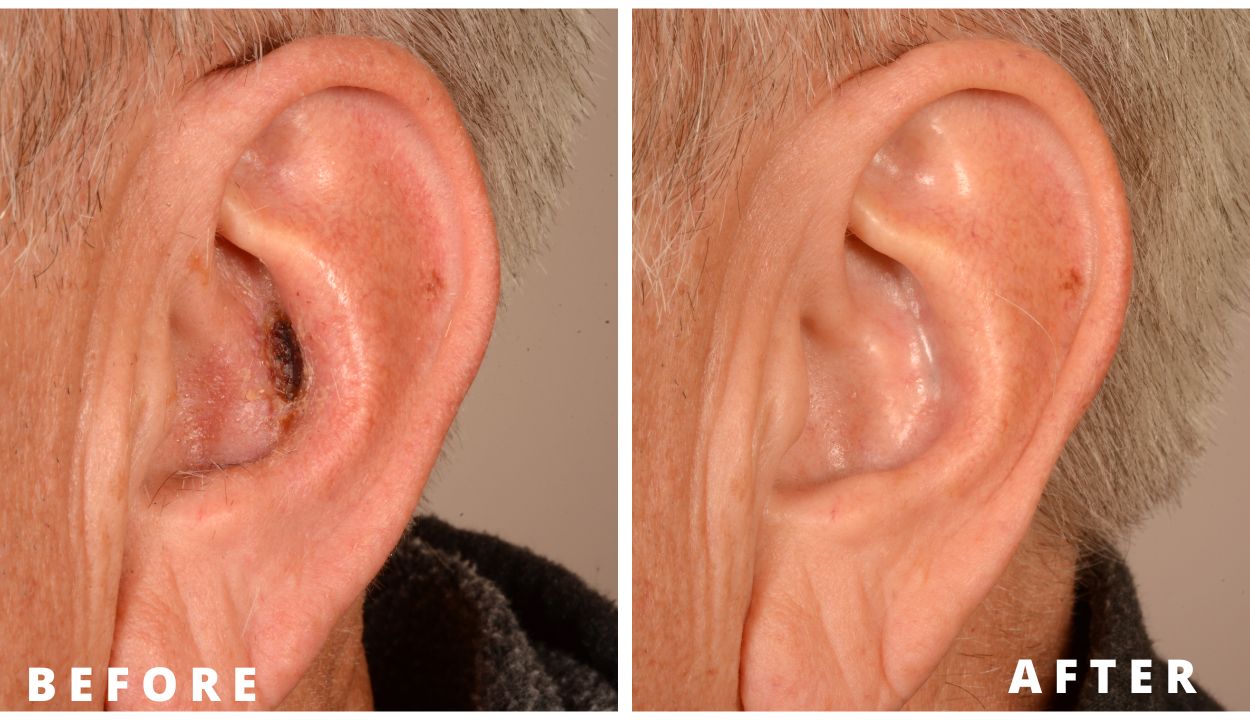
What Is Mohs Surgery and How Does It Work?
Mohs micrographic surgery is a technique developed in the 1930s and refined over decades into one of the most precise methods for removing skin cancer. During the procedure, a surgeon removes a thin layer of tissue from the cancerous site, examines it under a microscope on the same day, and repeats the process until no cancerous cells remain. This layer-by-layer approach means the surgeon can confirm clear margins in real time, which is a significant advantage over other surgical methods that rely on post-operative pathology.
Mohs is especially well-suited for cancers on the face, ears, nose, and other areas where preserving healthy tissue matters. It is performed under local anesthesia in an outpatient setting, and most patients go home the same day. Recovery involves wound care, and depending on the size and location of the excision, some patients may need reconstruction or experience visible scarring.
The cure rate for Mohs, when performed on appropriate candidates, is often cited at around 99% for primary basal cell carcinoma. It remains a cornerstone of skin cancer treatment for a reason.
What Is IG-SRT, and How Is It Different From Mohs?
IG-SRT stands for Image-Guided Superficial Radiation Therapy. It is a non-surgical approach to treating skin cancer that uses precisely targeted, low-energy radiation to destroy cancer cells without cutting into the skin. The image-guidance component is what distinguishes IG-SRT from older forms of superficial radiation therapy. Real-time ultrasound imaging allows the treating physician to visualize the tumor beneath the surface before and during treatment, which improves targeting accuracy and helps protect surrounding healthy tissue.
This is a form of SRT. The difference is that earlier SRT was delivered without real-time imaging, relying on surface measurements alone. The addition of image guidance represents a meaningful clinical advancement, allowing for more precise depth calibration and ongoing monitoring throughout the treatment course.
Treatment is delivered over multiple sessions, typically spread across several weeks. There are no incisions, no anesthesia, and no wound care afterward. Patients can generally return to normal activities immediately following each session.
How Do IG-SRT and Mohs Surgery Compare?
Both treatments are designed to eliminate skin cancer. They differ significantly in how they accomplish that goal. The table below outlines the key differences side by side.
| Mohs Surgery | IG-SRT | |
| Procedure type | Surgical | Non-surgical, radiation-based |
| Anesthesia required | Yes (local) | No |
| Incisions or stitches | Yes | None |
| Scarring risk | Possible, varies by site and size | Minimal to none |
| Recovery period | Wound care required; activity restrictions | Minimal downtime |
| Number of visits | Typically one day | Multiple sessions over several weeks |
| Suitable for surgical candidates | Yes | Yes, and also for non-surgical candidates |
| Cosmetically sensitive areas | Effective; may leave a scar | Often preferred |
The most important thing this table illustrates is that neither treatment is universally superior. Mohs achieves very high cure rates in surgical candidates. IG-SRT achieves comparable outcomes in appropriate candidates, particularly those for whom surgery presents greater risks or concerns. The decision depends on the individual patient, the tumor, and a thorough evaluation by a qualified dermatologist. IG-SRT works well for recurrent skin cancer and is better than Mohs for areas where precise tissue sparing is critical.
Is Mohs Surgery Really Necessary?
This is one of the most common questions patients have after being referred to a Mohs surgeon, and it is a fair one to ask. Mohs is highly effective, but effectiveness alone does not make something mandatory. Whether Mohs is the right choice depends on factors including the type and size of the tumor, its location on the body, whether it is a primary or recurrent cancer, and the patient’s overall health and surgical candidacy.
For some patients, particularly those with tumors in low-risk locations, those who are on anticoagulant medications, or those with anxiety about surgery, a non-surgical treatment like IG-SRT may be equally appropriate and better suited to their circumstances. The conversation should not be framed as Mohs versus doing nothing. It should be a discussion of which evidence-based treatment aligns best with the patient’s clinical profile.
Asking your dermatologist whether alternatives exist is not second-guessing a recommendation. It is a reasonable part of understanding your options before making a decision about your care.
What Can You Do Instead of Mohs Surgery?
IG-SRT is the most clinically established non-surgical alternative to Mohs for appropriate skin cancer cases. Other options exist across the broader spectrum of skin cancer treatment, including standard surgical excision and, for very early-stage or superficial lesions, topical treatments. However, these have different indications and are not interchangeable with Mohs for the same set of tumors.
IG-SRT is most often considered for patients who meet one or more of the following criteria, though this list is not exhaustive, and candidacy should always be evaluated individually by a dermatologist.
- Patients who cannot safely undergo surgery due to health conditions or medications.
- Older patients for whom wound healing or surgical recovery may be more difficult.
- Patients with tumors in cosmetically sensitive areas where scarring is a significant concern.
- Patients who prefer to avoid surgery and have tumors that are clinically appropriate for radiation-based treatment.
It is worth noting that IG-SRT is not a workaround or a second-tier option. For qualifying patients, it is a first-line treatment choice that delivers strong outcomes without the recovery demands of surgery. IG-SRT works well for recurrent skin cancer and is better than Mohs for areas where precise tissue sparing is critical.
How Do You Know Which Treatment Is Right for Your Skin Cancer?
There is no single answer that applies to every patient, but understanding how Mohs surgery and IG-SRT differ across the factors that matter most can help you have a more informed conversation with your dermatologist.
| Factor | Mohs surgery may be better if… | IG-SRT may be better if… |
| Tumor complexity | The cancer is recurrent, aggressive, or has unclear margins | The cancer is recurrent, deeply invasive, or classified as an aggressive subtype. |
| Location | The tumor is in an area where precise tissue-sparing is critical | The tumor is in areas where precise tissue sparing is critical and in locations not reachable with radiation. |
| Health history | You are otherwise healthy with no wound-healing concerns | You take blood thinners, heal slowly, or are not a good surgical candidate |
| Personal priorities | You prefer a single visit and a faster resolution | You want to avoid surgery, anesthesia, or scarring |
Before committing to either treatment, ask your dermatologist:
- Am I a candidate for IG-SRT, and if not, why?
- What are the expected outcomes for my specific tumor type and location with each option?
- What does recovery look like for each treatment?
- Are there any factors in my health history that would make one option safer or more appropriate?
- What happens if the initial treatment does not achieve clear margins?
These are not adversarial questions. Any experienced dermatologist should welcome them. If your consultation has not yet included a discussion of both surgical and non-surgical options, that is the right place to start.
Ready to Explore Your Options?
At Haber Dermatology, we take the time to evaluate each patient’s individual situation before recommending a treatment path. Dr. Robert Haber is a board-certified dermatologist with decades of experience treating skin cancer in patients across Cleveland and the surrounding area. Our Beachwood office offers comprehensive consultations where we walk through all appropriate treatment options, including IG-SRT, so you can make a well-informed decision about your care. If you have been diagnosed with skin cancer and want to understand every option available to you, we encourage you to book a consultation with our team.

Meet Robert Haber, MD, FISHRS
Dr. Haber is considered one of the finest hair transplant surgeons in the world, and lectures internationally each year. He also directs the region’s busiest private clinical trials unit studying new medications.
In 2023, Dr. Haber was the recipient of the prestigious Manfred Lucas Lifetime Achievement Award by the ISHRS, for his exceptional contributions and commitment to the field of hair transplantation. Only 15 other surgeons globally have ever received this honor.
The International Society of Hair Restoration Surgery (ISHRS) awarded Dr. Haber the coveted Golden Follicle Award in 2009 as one of the world’s top hair transplant surgeons, in recognition of his academic contributions and surgical skills.