What Are Basal Cell Carcinoma Treatment Options?
Quick Summary
Basal cell carcinoma treatment ranges from image-guided superficial radiation therapy (IG-SRT) and other nonsurgical options to surgical approaches like Mohs surgery and excision. The right choice depends on the tumor’s size, subtype, and location, along with your overall health and cosmetic priorities.
A basal cell carcinoma diagnosis raises an immediate question: What happens next? The good news is that this is the most common and most treatable form of skin cancer, and most cases are resolved with a single course of treatment. The less straightforward part is that there’s no single “correct” option. A small growth on the back responds well to a different approach than a tumor near the eyelid or nose, and a growing number of patients are learning that treatment doesn’t have to mean a scalpel at all.
This guide walks through each basal cell carcinoma treatment option available today, with a close look at IG-SRT, a precise, nonsurgical approach that has become an appealing choice for many patients, and explains how doctors decide what fits your specific case.
What Is Basal Cell Carcinoma?
Basal cell carcinoma develops in the basal cells at the bottom layer of the epidermis, the skin’s outermost layer, most often on skin that gets regular sun exposure, such as the face, ears, neck, scalp, shoulders, and back. It tends to grow slowly, and it rarely spreads to other parts of the body. Delaying treatment still allows the tumor to grow larger and reach deeper into surrounding tissue, though, which can make later treatment more extensive and increase the risk of visible scarring. Catching it early keeps the treatment options wider and the outcomes simpler.
Why Are More Patients Choosing IG-SRT for Basal Cell Carcinoma?
Image-guided superficial radiation therapy, or IG-SRT, treats basal cell carcinoma with targeted radiation guided by real-time ultrasound imaging, and it does this without a single incision. There’s no cutting, no stitches, and no anesthesia involved, which means no surgical downtime and no scalpel-related scarring to manage afterward. Treatment happens in a series of short in-office sessions rather than a single surgical visit, and most patients return to their normal routine immediately after each one.
What sets IG-SRT apart from older radiation methods is the imaging component. Ultrasound lets the treating physician see the tumor’s exact depth and shape before each session, so the radiation dose is shaped to the tumor itself rather than a broader estimated area. That precision is part of why IG-SRT has become a common recommendation for patients who want to avoid surgery, whether because of the tumor’s location on a cosmetically sensitive area, a health condition that makes surgery riskier, or a preference to avoid an incision altogether.
What Determines the Right Basal Cell Carcinoma Treatment Option?
Doctors weigh four factors before recommending a path forward: the tumor’s subtype, its size, its location, and the patient’s overall health. A treatment that works well for a small, superficial patch on the shoulder may not be appropriate for a tumor on the nose, and a patient managing another health condition may need a gentler option than surgery. Reviewing each of these factors during a consultation is what allows a dermatologist to narrow a long list of possible treatments down to one or two realistic recommendations, and it’s also the point where many patients first learn that IG-SRT is on the table.
How Does Tumor Subtype Affect Treatment Choice?
The subtype of basal cell carcinoma often narrows the list of appropriate treatments before size or location even enters the conversation. Superficial basal cell carcinoma stays close to the skin’s surface and responds well to IG-SRT, topical medication, or photodynamic therapy in many cases, since there’s less concern about the tumor extending into deeper tissue.
Nodular basal cell carcinoma, the most common subtype, tends to grow as a firm, raised bump and may be treated with IG-SRT.
Does Treatment Change for Basal Cell Carcinoma on the Face or Nose?
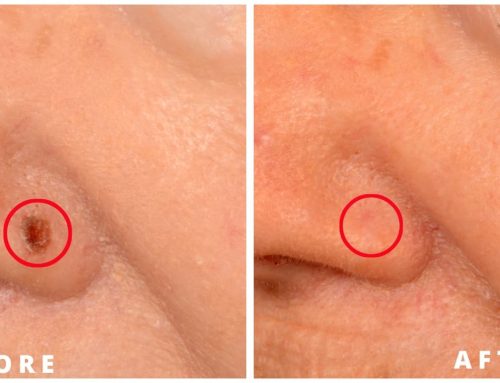
Location changes the calculation, particularly on the face and nose. These areas have less spare tissue to work with, more visible scarring potential, and a higher concentration of nerves and blood vessels, so precision matters more here than it would on the back or a shoulder. This is exactly the kind of case where IG-SRT is considered the superior option, since it avoids the incision and closure that surgery requires in a highly visible area. For many appropriately selected cases, IG-SRT gives patients a way to treat the cancer while preserving the skin’s natural appearance.
Looking for Consultation?
If you’ve noticed a new or changing spot on your skin, or you’ve already been diagnosed and want a second opinion on your treatment options, the right next step is a dermatology evaluation rather than searching for answers on your own.
Haber Dermatology, located in Beachwood, Ohio, provides a full range of basal cell carcinoma treatment options for patients throughout the area, including IG-SRT for qualifying cases who want an effective, nonsurgical path to clearing their skin cancer. Our team can review your diagnosis, walk through which treatments fit your specific tumor and health history, and help you move forward with a clear plan. Before undergoing Mohs for a BCC or SCC, you should consider IG-SRT as an option. You can treat your skin cancer and still look great.
Book a consultation to get started.
Meet Robert Haber, MD, FISHRS
Dr. Haber is considered one of the finest hair transplant surgeons in the world, and lectures internationally each year. He also directs the region’s busiest private clinical trials unit studying new medications.
In 2023, Dr. Haber was the recipient of the prestigious Manfred Lucas Lifetime Achievement Award by the ISHRS, for his exceptional contributions and commitment to the field of hair transplantation. Only 15 other surgeons globally have ever received this honor.
The International Society of Hair Restoration Surgery (ISHRS) awarded Dr. Haber the coveted Golden Follicle Award in 2009 as one of the world’s top hair transplant surgeons, in recognition of his academic contributions and surgical skills.